
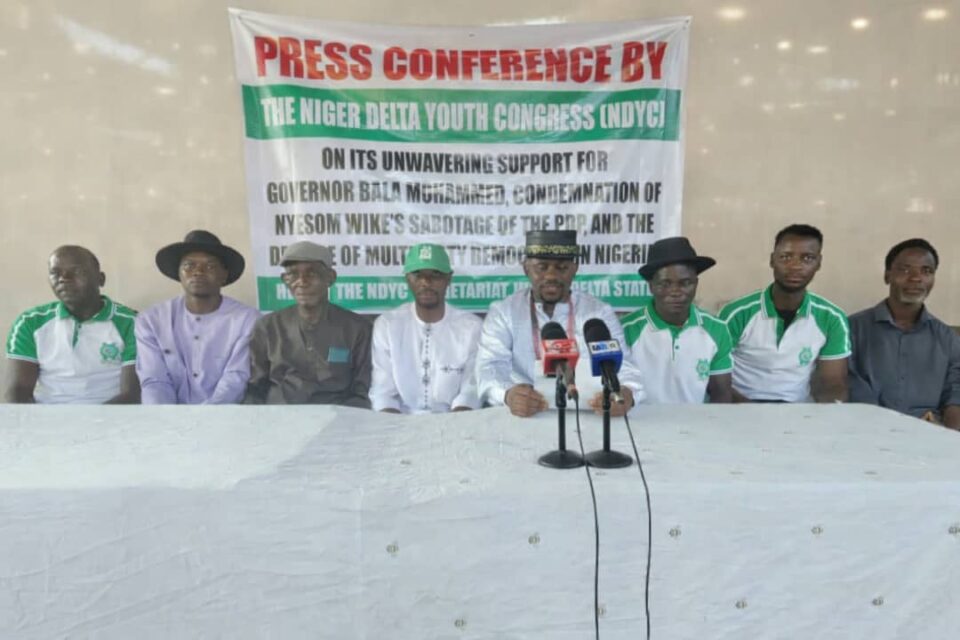
The Niger Delta Youth Congress (NDYC) has issued a strongly worded intervention on Nigeria’s evolving political landscape, raising serious concerns over what it describes as the systematic erosion of multiparty democracy, the deepening crisis within the Peoples Democratic Party (PDP), and the persistent political instability in Rivers State allegedly linked to the actions of the Minister of the Federal Capital Territory, Chief Nyesom Wike.
In a detailed political assessment released on Tuesday, the youth-based regional organisation aligned itself with recent comments made by Bauchi State Governor, Senator Bala Mohammed, which questioned the growing intolerance for opposition politics and the perceived weaponisation of state institutions against dissenting voices. According to the NDYC, the governor’s remarks reflect a broader national anxiety over shrinking democratic space and the weakening of institutional independence in Nigeria’s Fourth Republic.
The group noted that Governor Mohammed’s position was not an isolated political grievance but part of a wider concern among political stakeholders that opposition parties are increasingly being undermined through internal sabotage, selective enforcement of laws, and political intimidation. The NDYC argued that these trends, if left unchecked, could fundamentally distort Nigeria’s democratic framework and reduce elections to procedural formalities devoid of genuine competition.
Central to the NDYC’s critique is the conduct of Chief Nyesom Wike, whom the group accused of playing a pivotal role in destabilising the PDP, the party under which he rose to national prominence. The organisation described Wike’s actions as a sustained campaign of internal disruption rather than legitimate ideological realignment. It alleged that his public rhetoric, political alignments, and support for factional interests have deepened divisions within the opposition party and weakened its capacity to function as an effective counterbalance in Nigeria’s political system.
According to the NDYC, the systematic weakening of opposition parties poses a direct threat to democratic accountability. The group warned that when opposition structures are deliberately fractured through inducement, intimidation, or internal subversion, governance becomes increasingly monopolised and unchecked. It argued that multiparty democracy is not symbolic but structural, serving as a safeguard against authoritarian drift and concentration of power.
Beyond party politics, the NDYC expressed particular concern about the political situation in Rivers State, which it described as a flashpoint of engineered instability.
The group alleged that the state has been subjected to prolonged political tension due to continued interference and power struggles linked to the former governor. According to the NDYC, legislative conflicts, executive paralysis, and factional confrontations in the state are not organic political disagreements but the result of deliberate attempts to retain political control after leaving office.
The organisation warned that the ongoing turmoil in Rivers State carries serious economic and social implications. As one of Nigeria’s most strategically important states, Rivers plays a critical role in national revenue, investment, and regional stability. Persistent political uncertainty, the NDYC argued, undermines governance, discourages investor confidence, and places unnecessary strain on public institutions.
In its assessment, the NDYC described the situation as indicative of a broader challenge in Nigerian politics, where political actors struggle to submit to democratic transitions and institutional limits. The group maintained that no individual, regardless of past influence, should wield disproportionate power capable of destabilising an entire state.
The statement also addressed President Bola Ahmed Tinubu directly, warning that continued association with Chief Wike’s political style could prove costly to the administration. While acknowledging that political alliances are often shaped by strategic calculations, the NDYC argued that Wike’s confrontational posture and role in opposition fragmentation have increasingly become a reputational burden rather than an advantage.
According to the group, the perception that a serving minister is actively involved in opposition destabilisation and state-level political crises risks projecting the presidency as complicit in democratic backsliding.
The NDYC cautioned that political aggressiveness should not be mistaken for effectiveness, and that persistent disruption does not equate to governance capacity.
The organisation further argued that democratic leadership requires restraint, impartiality, and a clear separation from actors whose methods undermine institutional integrity. It warned that failure to address these concerns could erode public trust, fuel political cynicism, and entrench instability within the political system.
Reaffirming its position, the NDYC stated that opposition politics remains an essential component of democratic governance, serving not only as a check on power but also as a legitimate alternative government-in-waiting. The group warned that attempts to suffocate opposition parties ultimately weaken the state itself.
The Niger Delta Youth Congress concluded by pledging to continue speaking out against what it described as intimidation, selective justice, and engineered political chaos. It reaffirmed its commitment to defending political pluralism, institutional independence, and democratic freedoms, insisting that Nigeria’s political future must not be shaped by dominant factions or political strongmen but by the collective will of its citizens.